Cross the border and move the limits for green energy
Denmark has a long and proud history with renewable energy and a unique position in green technologies, hydrogen, and e-fuels. That means you will find strong competencies across the entire hydrogen value chain and production of e-fuels here, and you can contribute to the corner of Power-to-X research that makes you tick.
Combine that with world-class researchers and a strong tradition for public-private partnerships, and you have the ideal conditions for doing research that can move boundaries and make a lasting impact on the world.

Daniel Rasmussen

PhD scholarship in Operando Electron Microscopy of Solid Oxide Electrolysis Cells
You will contribute to solving one of the key challenges in green energy: making solid oxide electrolysis cells (SOECs) last longer. SOECs are the most efficient technology for producing hydrogen and other fuels from renewable electricity, but their commercial potential is held back by gradual performance loss. In this project you will use state-of-the-art electron microscopy, operating under real cell conditions, to watch degradation and recovery happen at the nanoscale, in real time. Your findings will directly inform how future electrolysis systems are operated and designed.
Postdoc in Dynamic Modelling, Simulation and Optimization of Power-to-X Processes
You will develop and apply dynamic process models based on mass and energy balances, thermodynamics, reaction kinetics, and equipment behaviour to simulate integrated Power-to-X plants under changing operating conditions. The work will address renewable fuel production, particularly green methanol and sustainable aviation fuels through methanol-based and Fischer–Tropsch pathways. The work will focus on electrolysers, fuel-synthesis processes, energy storage, heat integration, and interactions with the electrical grid.
PhD scholarship in Atomistic Stabilization in Solid Oxide Electrolysis Cells
Solid Oxide Electrolysis Cells (SOEC) are among the most efficient technologies for producing green hydrogen, but their long-term stability remains a key challenge for large-scale deployment. In this PhD project, you will use density functional theory and state-of-the-art machine-learning interatomic potentials to study SOEC electrode materials at the atomic scale and at length scales that were previously out of reach. The aim is to understand what governs electrode stability and how it can be improved. You will validate your simulations against advanced experimental characterization data.

PhD Position in Process Simulation and Techno-Economic Optimization of Large-Scale Power-to-X System...
The PhD project aims to develop and apply advanced process simulation and techno-economic optimization frameworks for large-scale PtX systems. A central focus will be on linking detailed process simulations with techno-economic models to evaluate alternative process configurations, identify opportunities for sector coupling, and optimize technology capacities and operating conditions. The project will also investigate how electricity prices, renewable electricity availability, hydrogen, biogas and CO2 supply, and process flexibility influence the economic performance of industrial-scale PtX facilities. The research will combine process simulation tools, particularly Aspen Plus, with computational modelling and optimization approaches.
Postdoc in Creative Electrosynthesis Reactions
The primary responsibility of this position is characterizing and testing electrocatalysts for electrosynthetic reactions either in aqueous or non-aqueous solvents. This could also entail operating at temperatures up to 200 ℃ and 20 bar. In-line gas chromatography or mass spectrometry will be used to measure gas products whereas HPLC or NMR will be used to measure liquid products. We have H-cells, gas diffusion flow cells, zero gap membrane electrode assembly cells, and electrochemical mass spectrometry, which allows for a variety of reactor designs that could be used for this project. As renewable energy continually becomes cheaper, the overall approach to sustainability is to electrify as much as possible. The chemicals industry produces 1000’s of chemicals thus there is substantial need for new research in electrochemical conversion to chemicals. While topics such as water electrolysis, CO2/CO electrolysis, ammonia synthesis are well researched, there is an urgent need for new and creative electrosynthesis reactions, especially those with high potential for economic viability. These types of reactions need original research to understand the fundamental science behind the new reactions, so that they can robustly grow in the future. That is what this project looks to investigate. The creativity and aim of this project relies on you. Thus this is a relatively open postdoc position in what the end goal will be as long as it relates to new electrosynthesis reactions. We are looking for somebody that has an idea outside the standard electrochemical reactions that are commonly researched. The proposed idea and project needs to fall within the capacities and direction of the pioneer centers for accelerating P2X materials discovery (https://capex.dtu.dk/) and the surface and catalysis (SurfCat) section within DTU Physics. As a whole, we expect this project will focus on developing the electrosynthesis reaction, and then using the CAPeX center and SurfCat infrastucture as a means to help determine what is the optimal catalyst and means of synthesizing and characterizing the catalyst. This is a purely experimental position, but will involve collaboration with computational chemists.
Postdoctoral Researcher in Process Modelling, Integration and Techno-Economic Analysis of Reversible...
The successful applicant will contribute to a project focused on integrating reversible solid oxide electrolysis and fuel-cell operation with biogas production, biological methanation, and heat recovery. The advertised position has become available through an Energy Technology Development and Demonstration Programme (EUDP) Project from the Danish Energy Agency, called DyneMe. The project aims to demonstrate how a 300 kW second-generation Dynelectro electrolyser unit can boost biogas methane production from existing feedstock, maximise energy efficiency and provide grid-balancing capabilities through dynamic electrolyser load and when relevant fuel cell operation. The research will combine process simulation, system integration, optimisation, and techno-economic analysis to evaluate flexible operation.
PhD scholarship in Catalytic CO₂ Conversion to Carbon Nanotubes
The project aims to discover catalytic materials capable of converting CO₂ directly into carbon nanotubes (CNTs), combining climate-change mitigation with the sustainable production of next-generation functional materials. Carbon nanotubes are among the most sought-after nanomaterials due to their exceptional strength, low weight, electrical conductivity, and thermal stability. They are key components in future energy technologies, electronics, and lightweight structural materials. Yet, conventional CNT production relies on fossil-derived feedstocks and carries a substantial carbon footprint. This PhD project seeks to establish an entirely new catalytic paradigm in which captured CO₂ becomes the raw material for producing high-value carbon nanomaterials.
Postdoc of Theoretical Catalysis
In the Theoretical Catalysis group, we aim to provide a deeper understanding of catalytic processes and catalytic materials by atomic scale simulations. We have a special interest in electrocatalytic reactions and high entropy materials, and the methods include DFT-simulations, machine learning potentials, Monte Carlo simulations and statistical analysis. We enjoy a close collaboration with experimental groups, both at the department and other universities in Denmark and abroad.
Marie Curie (MSCA) PhD scholarship in solar-driven hybrid methane production technologies for bio-el...
Your overall focus will be to advance the development of a sustainable photo-electrochemical process for methanation using biogenic CO2. You will work in close collaboration with an interdisciplinary research team in Water Technology and Processes section at DTU Sustain, combining environmental engineering, biotechnology, electrochemistry and process optimization to achieve more efficient CO2-to-CH4 conversion. The PhD position is funded by MSCA Doctoral Networks program.
ASSOCIATE PROFESSOR IN FUNCTIONAL MATERIALS CHEMISTRY
Do you want to develop functional materials that contribute to sustainable energy and chemical-conversion technologies? And do you see yourself as a team player who is strong in collaboration? If yes, we look forward to reading your application to our position as Associate Professor.
What makes your engine run?
We don’t have to tell you that excelling in Power-to-X is about optimising the complex interplay between the production and consumption of green energy and the critical infrastructure that connects everything.
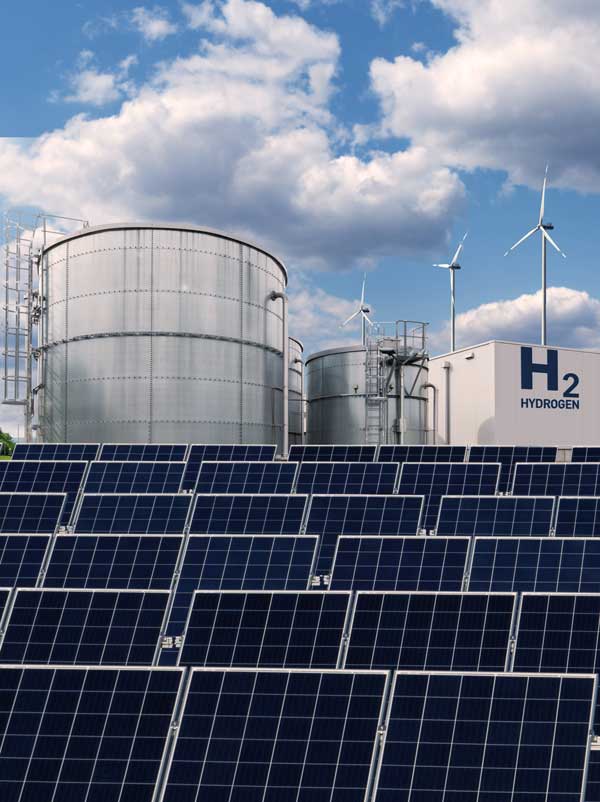
But did you know that Denmark is strongly represented in all aspects of Power-to-X? This includes deep expertise in wind energy, innovative electrolyser technologies, an ambitious transport sector, extensive district heating grids, and first-class technology providers.
Whether you focus on the production, consumption, or distribution aspects of Power-to-X, Denmark is the ideal place to pursue your ambitions.

Meet Power-to-X like-minded
From Brazil and Iran to tiny Denmark
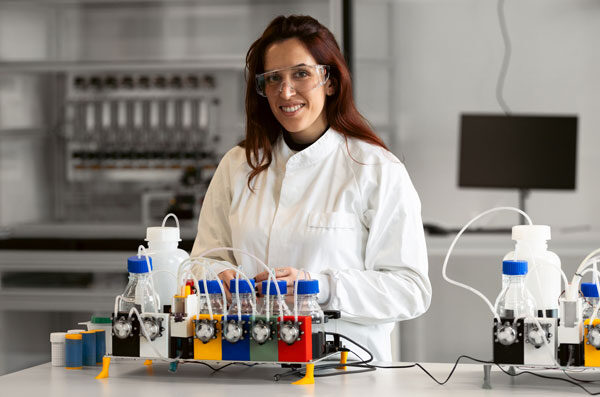
Maryam, originally from Iran, arrived in Denmark after spending several years abroad. Now an Assistant Professor at DTU, she designs catalysts and electrolysers that help drive the green energy transition.